Monday, May 05, 2008

Newfoundland iceberg spotting season

People have begun to flock to the coasts of Newfoundland and Labrador on a hunt for icebergs, according to the Canadian Tourism Commission. The stretch of water between the northern tip of Labrador and the eastern shores of the Avalon Peninsula is known as iceberg alley at this time of year, when the sea carries mountains of ice close to land.
Icebergs tens of thousands of years old, which were once part of the Greenland icecap, are buffeted by wind and tide, breaking into smaller chunks before melting in the warm waters south of Newfoundland and Labrador.
According to the International Ice Patrol, 2008 could be a highly active year for iceberg sightings. The agency has been monitoring the movement of the ice since February and has reported more than 500 icebergs moving south from Greenland, compared to only 50 last year. Newfoundland and Labrador rely on iceberg-spotting as part of their tourism industries and visitors can join organised kayak or boat tours, or can simply stand on the shoreline to watch the massive bodies of ice float by.
Story: Opodo

Sunday, March 30, 2008

FOR SALE: Strawberry Hill Resort

"Every asset of most companies is for sale at the right price at the right time" ... and for Humber Valley Resort that includes its Strawberry Hill Resort. Strawberry Hill is up for sale for a cool £3.3M (approx $6.7M).

Its being marketed through "Country Life", as potential boutique hotel, corporate lodge, or even as a private home.

Being the only real fine dining restaurant in the area - we've all got to hope it remains a tourism commercial property - the valley is desperate for cafes and restaurants!

Thursday, March 20, 2008

Evening Snowmobile Ride on Marble Mountain

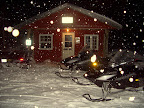
We team up with local friend John and his wife Marilyn, and her two sisters - for a night time snowmobile ride. WOW - this was good. Its snowing, with a full moon, and of course freezing cold. The ride, starting from My Newfoundland Adventures shop at Steady Brook, goes up the side of Marble Mountain (due south) ... and is a clearly marked trail. (Its the one MNA use for their 2 hour ride for first timers.

Frustratingly for local snowmobilers, the trail is not groomed often enough ... but even so, its a good run, and after about 40 minutes we arrive at the Chill-Down-Shack.

From Snowmobiling-...
These shacks are maintained by the Trial Association - all local snowmobile owners buy a trial sticker (approx $75 pa) which helps support the grooming and shacks etc - its really an oversized garden shed ... but equally, a welcome sight when its cold and you're looking to warm up and have some lunch! Inside is a iron stove, a pile of wood and a picnic bench. Its clean, tidy and obviously cared for - despite the remoteness of its location ... (wouldn't last one night in the UK without being burnt down by some dim-wit youth!).

John connects a cable from the shack to his snowmobile and suddenly theres lights in the cabin. (How very unexpected, and civilised). He reappears in the shack with an axe (!!) and quickly dices up some logs, sets the fire, and breaks out the hot chocolate. We all share stories about our Dog Sledding experiences in Gros Morne - and general amusement about the snowmobile ride.

Interestingly, the three sisters keep referring to Cinderella - but we've not yet worked out which one is which (if you see what I mean).

We clear our mess, and fire up the sleds - and in 40 short minutes we're back down at the base of Marble Mountain. We're all very happy, smiling and generally feeling we've had another great evening - beats wasting a night watching Eastenders, or worst, spending the night flicking through the Canadian satellite channels ... and I thought Sky was poor ... not any more!

Joking apart ... we've had a great evening - you should try an "Evening Snowmobile Ride" - A lot of fun!

Wednesday, March 12, 2008

HVR Owners: Sheldon leaves HVR

Sheldon Colbourne (HVR Construction Manager, amongst several recent new titles) leaves Humber Valley Resort early April. Our understanding is he has recently resigned, and is joining a new company on the east coast of NFLD near St Johns.

We wish him, and his family (which now includes twins!) the very best of luck, in their new venture.
KDG.

New-found-land - An Ideal Place For Winter Sports

"An Ideal Place For Winter Sports”

The reality of Newfoundland is far different than my misguided perceptions. The province is farther south in latitude than England, and the climate is fairly temperate. The average winter temperature is minus-5 degrees Celsius (about 23 degrees Fahrenheit), and in late February and March, sunny days often outnumber any other climatic pattern. All this makes Newfoundland an ideal place for winter sports—from skiing to snowmobiling.

By Peggy Shinn SkiSnowboard.com & MSNBC

As we kicked and glided along the frozen, snow-covered fjord, we weren’t really watching where our skis were going. The surrounding 2,500-foot snowy mountains, set against a cloudless blue sky with their ice-speckled cliff faces plunging into the fjord, kept our attention focused upward. We heard melt-water pouring off a snowfield high in a glacial cirque to our left and a raven cawing in a stubby spruce forest to our right. Far ahead, the fjord narrowed and vanished around a bend.

We stopped to drink from our water bottles and apply more sunscreen. Wearing two shirts, a fleece top, and a jacket, I was sweltering in the late February sun in a mountain landscape I thought only existed in the Alps or Alaska. Who knew Newfoundland was so warm? And so stunning? Where was the fog? The frigid arctic temperatures? The feeling that we were at the end of the earth, or at least close to it?

My perception of Newfoundland—garnered from reading “The Shipping News” by Anne Proulx (who called the island “six thousand miles of coast blind-wrapped in fog”), “The Boat Who Wouldn’t Float” by Canadian author Farley Mowat (who wrote, “most Southern Shore Newfoundlanders acquire a taste for rum soon after abandoning their mothers’ breasts”), a few Newfie jokes remembered from junior high school, and just looking at a map—was that it was a desolate, desperate, windswept place somewhere near Greenland and populated by drunken misfits. I half expected to be served Screech, the province’s unique form of rum, and cod tongue at every meal.

The reality of Newfoundland is far different than my misguided perceptions. The province is farther south in latitude than England, and the climate is fairly temperate. The average winter temperature is minus-5 degrees Celsius (about 23 degrees Fahrenheit), and in late February and March, sunny days often outnumber any other climatic pattern. Even more welcome news: Without the winter rains that often plague New England, Newfoundland’s prodigious snow-pack stays soft, similar to the snow in the Rockies. All this makes Newfoundland an ideal place for winter sports—from skiing to snowmobiling.

Our trip began with two beautiful days backcountry skiing in Gros Morne National Park, an isolated stretch of wilderness punctuated by dramatic land-locked fjords and tree-less mountains. The map had labeled the large land-locked fjords (which became land-locked after the glaciers retreated thousands of years ago) as “ponds”—and we soon learned that Newfoundlanders are prone to understatement. We kicked and glided for three hours until we reached Bakers Brook Pond, which was at least five miles long. After spending the night in park-service-maintained hut, we explored the stunning “pond,” making the only ski tracks that day across its snowy surface.

After our backcountry adventure, we headed south to Marble Mountain, Newfoundland’s major ski resort. Situated on an escarpment that plunges 1,700 vertical feet down to the shores of the salmon-filled Humber River, Marble has some serious skiing on gloriously soft snow. Locals claim that the lack of winter rain and freeze-thaw cycles keeps the snow softer than at Eastern ski resorts in the U.S. And with so few skiers and snowboarders, even on weekends, the place felt like our own.

Although Marble, with its 1,700 vertical feet and 35 trails, is small by destination resort standards, the entire region—Newfoundland’s central west coast—has a surprising number of amenities and activities. The resort itself has a modern 54,000-square-foot post-and-beam base lodge, and a small collection of ski-in/ski-out condominiums called Marble Villa. Ten minutes up the Trans Canada Highway, the Humber Valley Resort rents truly luxury homes. Families and friends can rent well-appointed 2,200-8,000 square-foot homes for the week for a fraction of the cost in the States or Europe. Three British friends sharing a Humber Valley chalet, as the homes are called, paid 1,200 Euros for the entire week. And they each had their own bedroom and bathroom.

The resort also offers a cruise-ship-style menu of activities—snowmobile tours, snowshoeing treks, helicopter skiing expeditions, or any other activity ever tried on snow. Humber Valley even has its own full-service spa. Yes, a pedicure in Newfoundland. Who would have thought?
Perhaps one of the best places to soak in the splendor of this remote island province is in the Blomidon (literally blow-me-down) Mountains, a 20-minute drive southwest of Marble Mountain. Blomidon Cat Skiing —the only snowcat skiing operation in the East—takes up to eight people and two guides in a Bombardier BR400 snowcat from the spruce and birch forests surrounding the Humber River Valley up to the treeless bowls and pistes of the Blomidons. From here, the views of the Gulf of St. Lawrence set against the barren Alpine slopes are worth the price of admission.

As we sat near an Alpine brook eating a picnic lunch, I picked up a rust-colored rock, one of many littering the brook’s bed. “That’s part of the earth’s mantle,” said our guide and Blomidon Cat Skiing owner Glenn Noel. He went on to say that this is one of the few places on earth where the mantle was thrust to the surface eons ago.

I looked up at the piste we had skied before lunch—a 25- to 30-degree face delineated by more rust-colored rock outcroppings. How many people can say they have skied the earth’s mantle, I wondered. Not many, I guessed. The Blomidons probably see as many skiers and snowboarders in a decade as more popular backcountry ski operations on the mainland see in a month.

Then it dawned on me. Maybe Newfoundlanders don’t want their secret out. Maybe they like the fact that mainlanders perceive the island as a desolate wasteland, that it’s not yet “found” by many people, except for them. For then they can keep the splendor all to themselves.

But I quickly backpedaled. Newfoundlanders not share? No way. They are far too generous not to share. They are the kind of folks who personally call you if your flight is delayed or share their stash of caribou sausage. As for the Screech and cod tongues, they shared those, too. But only when we asked.
By Peggy Shinn SkiSnowboard.com & MSNBC ... and credit to Gary Kelly

Sunday, March 09, 2008

Deer Lake Airport - Astraeus out & Monarch in

After a number of years enabling flights between London and Deer Lake, Astraeus (Flystar) announced this week that they will be ending their charter flights with Humber Valley Resort as of April 18th 2008.

Its understood that Monarch will be taking over, and Humber Valley Resort will be making their formal annoucement shortly. Flights in summer 2008 will be on a Thursday.


Full story - Western Star or FlyStar.com & Monarch

Thursday, February 07, 2008

Independent Newspaper - Dog Sledding with My Newfoundland Adventures

The Independent newspaper's, photo editor Paul Daly and managing editor Stephanie Porter spent a day with My Newfoundland Adventures, running a team of huskies through snow-covered Gros Morne and discovering a taste of the adventure tourism the island’s west coast has to offer


Although it’s crisply cold and snow­flakes hang in the early-morning air, the day’s forecast for the west coast of Newfoundland calls for rain later on. “St. John’s weather,” says one man at the Deer Lake airport, wrinkling his nose. “That’s the last thing we want.”

Unlike St. John’s and the rest of the Ava­lon Peninsula, of course, the island’s west coast boasts a definite winter, with constant snow that many — especially those in­volved in the tourism and winter sport busi­ness — count on for both their pastimes and livelihoods.
Martin Hanzalek, operations manager of My Newfoundland Adventures, would fall into this category. Headquartered in a cozy cabin at the base of Marble Mountain, the business offers short and long guided tours in just about any seasonal outdoor activity you can imagine — from a two-hour twi­light snowshoe to multi-day wilderness camping.

Currently in a bit of a post-Christmas lull, the guides and other staff are preparing for the February-March winter rush. A day of rain won’t do too much damage; there’s plenty of snow down, and plenty of fun to be had on it.
Hanzalek, 30, grew up in British Colum­bia, and knows first-hand the worth and at­traction of adventure tourism. An outdoor enthusiast and highly qualified guide, he’s also got formal training in adventure tour­ism management.

Hanzalek has been in this province for seven years and has no plans to leave a place where he can do so many of the things he loves. One of the founders of My New­foundland Adventures, now in its fourth year of operations, Hanzalek’s goal is sim­ple: to work with other skilled guides who can offer new experiences and share every­thing they find irresistible about the prov­ince with others.
“I love all of these programs, a lot of us do,” he says. “Sometimes there’s between 12 and 14 working here between contrac­tors and employees. All of us choose this for a lifestyle as opposed to what’s going to turn us the biggest buck.
“We specialize in non-consumptive, self-propelled, unique programs. We bring na­tionals and internationals that are visiting this province to special places. We take you off the beaten path …”
There are dozens of programs on offer this time of year — including snowshoe­ing, snowmobiling, cross-country skiing, ice-climbing, wildlife tracking, snow-kit­ing, ice fishing, wilderness survival, igloo-building and camping.And dog-sledding.
They’re the only company on the island offering dog-drawn tours and the opportu­nity is irresistible for many. As Hanzalek says, “there’s nothing more Canadian and more winter than running your own team of six or eight huskies through the snow-cov­ered forests at Gros Morne.”
•••
The sound of 34 dogs barking is an abrupt first greeting for guests arriving at the loca­tion Elaine Pinard has taken over for the winter (it’s a motorcycle museum and art gallery during the summer).
The Siberian huskies are all tied up on short leashes around their sleeping kennels, except the 14 — a team of six and a team of eight — that are to take part in this morn­ing’s run.
Those dogs, already in position and har­nessed in, are particularly excitable, jump­ing, wagging, whining and eager to hit the trails. This is the second winter Pinard has brought a team of dogs to the province. She and her partner, Richard, are based in Que­bec; he’s back at home this season, running the business from that end and minding the 100 or more other dogs they own.

(The couple connected when she had 40 dogs, he 80 — he’d been told he “had to meet the woman with all the dogs,” and the rest is history.) Pinard says she loves being in Newfound­land, revelling in her access to wide-open spaces, endless trails for her dogs, plenty of snow and eager and curious clients.
She knows all the animals by name, al­ways has, even when she had “a family” of 250. “And the vet asked if I could recog­nize them all from the back … almost,” she laughs.

They’re all Siberian huskies, which she chose over larger breeds like malamute or Eskimo because they’re smaller, efficient, and better around people. Even so, the dogs need about a pound-and-a-half of meat a day — they consume a combination of chicken and seal —along with dry food. (Last year they experiment­ed with more seal meat, Hanzalek says, but it was so high in protein and all the good Omega fats the huskies got too strong and kept breaking their chains.)

Before the mushing lesson, Pinard al­lows a few minutes to suit up and warm up in front of the wood stove in a shed on the property. And to meet Washi, a slightly old­er, and much beloved white husky that has made its way to the status of Pinard’s pet and apparent favourite.

There is some excitement around the possibility Washi may be pregnant; Pinard breeds the huskies as well, selling pups in Quebec for about $500 each. This year, though, she kept all 40-some newborns, to rebuild a strong, youthful team after retiring some older members.
•••
“Gros Morne is absolutely underutilized in the winter,” says Hanzalek, surveying the distant snow-covered hills. There’s at least six feet of snow down, even more than there is in Deer Lake or Corner Brook. Fifty years ago, British Columbia had a completely resource-based economy,” he continues.

“That’s still important, but now tourism is worth even more.”Does he believe that could happen in this province? “Sure, but a lot of people are go­ing to have to change the way they think,” he says. In other words, he’d like to see less focus cutting, excavating, extracting, kill­ing and drilling as the only ways to make money.
“The mill in Corner Brook, that will close some day,” he muses. “And you know what? People will be OK. There are other things to do.”
Hanzalek is full of stories and memories of trips he’s both taken and led, recounting the wide-eyed wonder of tourists as they see their first moose, successfully snow-kite, or catch a fish through the ice. He mentions one 89-year-old woman, a cruise ship pas­senger “sick of bus tours” who went on an easy river rafting trip — her first time on a river. And the delighted participants in the “chicks ’n’ picks” ice-climbing program.

Hanzalek also takes special pleasure in planning trips around a client’s specific wants, whether they are looking for an es­pecially challenging adventure or a multi-day, multi-activity group experience.
“These days, people are looking for something different,” he says. “They don’t always want another beach vacation, or a ski-only vacation.
“People are coming here for the things that are here to do. These experiences re­ally provide enrichment to your life, and are valuable. The climate’s rising, winter’s a rarity, and we still have great conditions here.
“There is a lot, a lot to see and do.”
•••
Mushing, or commanding, a team of well-trained huskies is intimidating at first, but not difficult — not on relatively even ground, at least. Anyone who takes part in a dogsled day with Pinard is offered the op­tion to try. Pinard’s instructions are quick, specific and to the point: lean when you’re going around a turn, let the dogs feel you push­ing a little with your feet when you’re on the level, walk with them going up steep hills. When you need to stop, put both feet on the brake and lean back. And whatever you do, even if your sleigh is going off the track and you’re worried about capsizing, never let go.
The wooden sleigh can hold a passenger and some gear; the musher stands behind, feet on the skis. With a push and an “Allez!” the dogs are off like a shot, heading for the trails, already well marked by snowmobile.
As the initial excitement of being out on a run wears off, the dogs settle into an even, peaceful pace. The winding trail through the woods opens up to a frozen lake and stun­ning views of the Tablelands and the rugged landscape of Gros Morne National Park.
Pinard offers dog day trips between two and seven hours — lunch and a warm-up by a wood stove are included — and is also planning for a week-long expedition. The dogs easily cover 15 or 20 kilometres in two hours; the week’s journey would cover more than 450.

Slipping through the quiet woods, pass­ing caribou, moose and other wildlife tracks, leaning with the movement of the sleigh, it’s hard to imagine a more idyllic way to spend a winter’s day. If two hours is enough to impress Newfoundlanders, it’s hard to imagine the impact the experience would have on travellers unused to large, quiet, open spaces and mountains of snow.
•••
Back at the My Newfoundland Adven­tures base, Hanzalek takes a moment to talk about the basic credentials of all the guides that work for the company — a particular point of pride for him.
“We feel strongly about providing all our clients with an exceptional duty of care, and in saying so, have minimum requirements for all our staff,” he says. “All our guides are experts in their fields, and are profes­sionals in the activities they guide.”

At a very minimum, all staff hold a val­id advanced wilderness first-aid certifica­tion, avalanche awareness training, and ice safety certification; staff working in and around moving water have swiftwater res­cue training; all climbing instructors have rope rescue training and appropriate climb­ing certifications
Hanzalek says his company has imple­mented minimum standards, as there are no legislated basic qualifications for tour guides in this province. (The Department of Tourism, Culture and Recreation confirms the province does not regulate adventure tourism operators; the industry and operators are responsible for having enough training, certification and insurance to protect themselves.)
Hanzalek advises any customer, no mat­ter which company they choose for a tour or expedition, to ask about staff training. He mentions his own lead climbing guide, Jesse Terry, who spends 200 days a year climbing rock and ice all over the world; or St. Anthony native Neil Pilgrim who is a kayak instructor, river canoe in­structor, experienced Alpinist, rope rescue team leader, professional level interpreter and more.
They also share a bond that cannot be measured by paper certifications — but which may be the difference in both show­ing off the province and running a business that succeeds.

“All our staff are here because they want to live and work in Newfoundland, do­ing what they love and do best,” Hanzalek says. “They are passionate about what they do … we have some amazing natural wonders right in our backyard, and as Newfound­landers, we are just beginning to recognize their true value and potential.” (Managing Editor - Stephanie Porter)


We're CrazyAboutNewfoundland.com ... Are you?